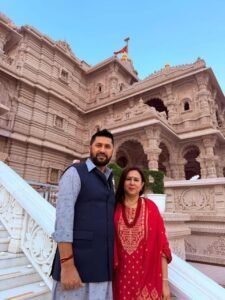
Ravi Lamichhaney’s Trip to India
1440,978,0,0.45,-1
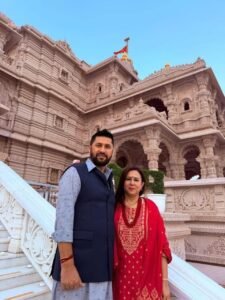
Ravi Lamichhaney, wife at
the Ayodhya Temple
What the trip could be telling us about
Nepal’s new place in the world
By Soren Neupane : ex Rising Nepal journalist writes on South Asian politics, culture from Wellington, New Zealand
Such a harried particular kind of diplomatic moment can and does stop observers in their tracks — not because it is raspy and loud, but because it is unexpectedly warm. When Rabi Lamichhane, Chairman of Nepal’s Rastriya Swatantra Party, arrived in New Delhi in early June 2026 on an official visit at the invitation of India’s ruling Bharatiya Janata Party, the reception he received was, by most accounts, extraordinary. Meetings with Prime Minister Narendra Modi. A sit-down with External Affairs Minister S. Jaishankar. Time with Home Minister Amit Shah and National Security Advisor Ajit Doval. The kind of schedule, observers noted, that is typically reserved for heads of state.
Nepal watchers winced and began making noises. The rest of the world, slowly but surely, began to notice too.
Why so serious?
To understand why this matters, you need to hold two ideas at once.
The first is that Nepal is small — with its geographical positioning and recent changes – has spent the better part of its modern history navigating that geography with a soft power instinct and the previously ‘not well managed’ and ‘corrupt’ governments for survival.
The second, and more crucial, is that Nepal, right now, is genuinely new. The Gen Z-led protests of September 2025 swept away a generation of political leadership that had alternated power in Kathmandu. High handedness, nepotism, bribery and you name it. All the no-no for good governance was lacking. And the baddies trend was more like a badge of honour. Dragging the country into a plot for c grade, cheap video clip. Titles for sale, clerks stationed outside some official entrances to enhance handover of bribery. You name it.
The RSP, a party barely four years old, now governs. Prime Minister Balendra Shah — the rapper-turned-politician who won Kathmandu’s mayoralty in 2022 and became the face of the uprising — leads a government that carries no Cold War debts, no inherited pro-India or pro-China alignments, and no interest in the old transactional arrangements that kept everyone comfortable and nothing moving. Or think some Nepalese.
That freshness is precisely what four of the world’s major powers — India, China, the United States, and Russia — are trying to figure out how to respond to. It’s a porridge too scalding to scoop and taste in haste.
India: the warmth and the wariness
For New Delhi, Lamichhane’s visit offered something it had quietly been hoping for since the elections: a reset. Indian commentators were quick to note the historic opportunity. Writing in the Hindustan Times, Lamichhane himself laid out his vision with a phrase that landed well on the Indian side of the border: ( Lamichhane, R. (2026, June 2 ). Exclusive: How can an aspirational Nepal and a rising India reconnect? Hindustan Times. ) “Nepal and India are not just two countries, we are stakeholders of a proud, ancient civilization.” It was the kind of line that resonates in Delhi’s policy circles, where the language of civilisational kinship carries real weight.
Indian analysts broadly welcomed the RSP’s approach of “development diplomacy” — a deliberate pivot away from the political friction of the recent past toward infrastructure, digital corridors, and hydropower cooperation. The Tribune quoted experts calling it a “historic chance” to elevate the relationship through energy and technology, finally moving beyond decades of transactional caution.
And yet. India is not yet fully at ease. ThePrint characterised Nepal’s current posture as a “two-layer India policy” — and the characterisation sticks. While Lamichhane presented a cooperative, forward-looking face in Delhi, Prime Minister Shah has taken a notably firmer line in Kathmandu: raising the border dispute in parliament, enforcing new border taxes, and declining to meet with Indian diplomatic envoys. The contested territories of Kalapani, Lipulekh, and Limpiyadhura remain unresolved. India’s recent resumption of the Kailash Mansarovar Yatra through the disputed Lipulekh pass has added fresh friction to old wounds. The Diplomat noted that New Delhi’s early enthusiasm for the new government has been tempered by these signals. The warmth extended to Lamichhane is genuine — but India is watching carefully to see which layer of that two-layer policy ultimately prevails.
China: – as usual – pragmatic, patient, recalibrating
Beijing’s response to the visit has been more measured — the careful observation of a power that has invested heavily and now needs to recalibrate. China built its Nepalese relationships on ideological affinity: the communist parties of the old order, K.P. Sharma Oli among them, were natural partners for BRI infrastructure ambitions. The RSP government, driven by youth demands for transparency and accountability, offers a different proposition. Chinese-backed projects will now face greater scrutiny on debt sustainability. The removal of the China-backed Jhapa Industrial Park from Shah’s election manifesto was read in Beijing as a signal — polite, but unmistakable.
Global Times continued to emphasise the importance of investment and connectivity to the Nepal-China partnership, and Beijing has not walked away from the table. But Lamichhane’s effusive reception in Delhi was noted and filed. China’s approach, for now, is pragmatic and patient: defend the existing economic footprint, wait to see how the RSP governs, and adapt accordingly. It is, in its own way, a kind of respect — the recognition that this new Nepal requires a new kind of engagement.
The United States: strategic opportunity, actively pursued
Washington views the Himalayan arc with the attentiveness of a power conducting a long game. The ouster of the communist parties registered in US policy circles not merely as a domestic democratic development but as a meaningful shift in the regional balance — an opening in what analysts describe as the larger strategic contest shaping South Asia. The US aims to limit Chinese almost upper-hand leverage in the region, and a Nepal led by pragmatic, transparency-minded reformers is, from Washington’s perspective, a more promising partner than the ideologically freighted governments of the past.

The Americans have not waited for an invitation. During Lamichhane’s Delhi visit, he met with Sergio Gor, the US Ambassador to India and Special Envoy for South and Central Asia. It was a deliberate signal: Washington is engaging directly with the pragmatists, even as Prime Minister Shah has kept US envoys at arm’s length in Kathmandu. The Millennium Challenge Corporation, the US-backed infrastructure initiative, is being positioned as a transparent, accountable alternative to BRI financing — and the RSP’s emphasis on accountability makes that pitch easier to land than it would have been a year ago.
Russia: reaching back, reaching out
Russia’s position – it appears – is the most constrained of the four, and Russian analysts appear to know it. The broader context — the war in Ukraine, international isolation, the controversial recruitment of Nepali nationals into Russian armed forces — has complicated what was once a relationship built on Soviet-era goodwill and infrastructure investment. Nepal’s vote at the UN condemning the Ukraine invasion did not go unnoticed in Moscow.
And yet Russia has not given up on the relationship. When the RSP government took office, Moscow was among the first to send congratulations. Russian commentary on Lamichhane’s visit frames Nepal’s new posture through the lens of strategic equilibrium — the RSP’s stated commitment to “balance in global politics” is a formula that suits Russia well, since it implies no alignment that formally excludes Moscow. Russian analysts see potential in reviving historical ties, proposing new infrastructure and trade initiatives that build on Soviet-era foundations. The path forward is narrow, and the bureaucratic and reputational hurdles are real. But the intent to remain present is clear.
The view from the mountains
What emerges from all of this is a picture of a small country — genuinely small, by any measure of population or GDP — that has, through the unlikely mechanism of a youth uprising, suddenly become interesting to everyone at once.
Lamichhane’s “development diplomacy” is more than a slogan. It is a bet: that a Nepal freed from the transactional logic of the old order can attract investment, build infrastructure, and improve lives without trading sovereignty for support. It is, in its ambition, a thoroughly RSP-flavoured idea — idealistic, tech-forward, impatient with the past.
Whether it holds depends on what happens next in Kathmandu. The two-layer policy India has identified — Lamichhane’s warm engagement abroad, Shah’s assertive nationalism at home — is not necessarily a contradiction. It may be a negotiating position. Great powers have played this game for centuries. The interesting question is whether a new generation of Nepali leaders, unburdened by the old scripts, can play it better than their predecessors did.
The reception in Delhi suggests, at minimum, that the world is willing to find out.